The
NGO Cooperation Project
title is: "Sufficiency
as Climate Action and for Sustainable Lifestyles in Nordic & Baltic
Countries and Belarus".
In this Project,
INFORSE-Europe is working together with CSOs from Denmark,
Sweden,
Estonia, Norway,
and Lithuania / Belarus during 2025-26. |
| News from the
Activities of the Project: |
|
Webinar, September 24,
2026 at 9-10 CEST
Launch
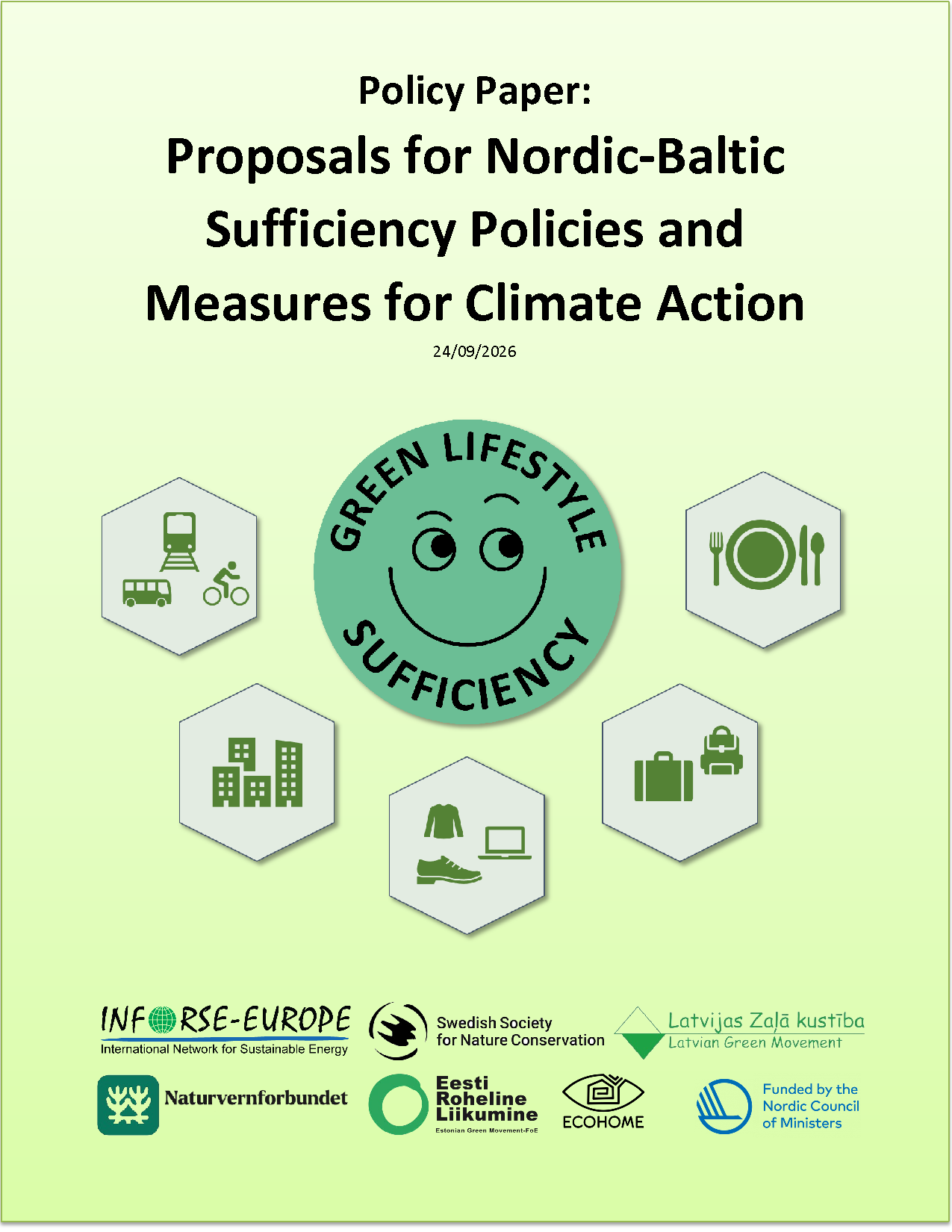
of Policy Paper: Proposals for Nordic-Baltic Sufficiency Policies
and Measures for Climate Action
Ppresentation of INFORSE-Europe and partners'
new policy paper, where we propose to introduce policies for
sufficiency
throughout
the economies.
We propose that sufficiency is introduced as an overarching
policy framework to stop increases in consumption and also to
reduce
consumption. For private consumption, we propose to focus on
five areas:
- Building
use, electricity, heating
- Transport
- Consumers
goods e.g., clothing, electronics, furniture
- Food
- Holidays
Download: Policy
Paper: Proposals for Nordic-Baltic Sufficiency Policies
and Measures for Climate Action (1.3 MB)
The
Policy Paper is developed as part of the Project “Sufficiency
as Climate Action and for Sustainable
Lifestyles in Nordic & Baltic
Countries and Belarus” with the partners of INFORSE-Europe,
Norges Naturvernforbund, Svenska Naturtskyddsforeningen, Latvian
Green Movement, Estonian Green Movement
and Ecohome NGO (Belarus hosted in Lithuania).
The Project is financed by the Nordic Council
of Ministers' Prosperous Future Grant Programme, and co-financed
by INFORSE-Europe, Norges Naturvernforbund, Svenska Naturtskyddsforeningen.
|
|
September
19, 2026 12:30 - 13:30
EU and Danish
politics for a more sustainable way of living organised with
VedvarendeEnergi (in Danish), with support
from Europa-NГvnet, part of Climate
Justice Days in Aarhus by Mellemfolkeligt Samvirke.
Cafe Mellemfolk, Mejlgade 53, 8000 Aarhus, Denmark
|
|
August
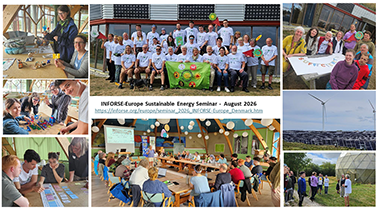
17-19 / 20, 2026
Sustainable Energy NGO
Seminar in Denmark
presenting the project results by the project partners
Venue: Nordic Folkecenter for Renewable Energy, Ydby, Denmark
More: Program
and Proceedings
|
| |
June
10, 2026
Brief on Sufficiency Measures in the Nordic Baltic
Countries
Launch at the EUSEW Fair on 10th June in Brussels
Download the
Final Policy
Paper: Proposals for Nordic-Baltic Sufficiency Policies and Measures
for Climate Action (1.3 MB) by the
partners of the Sufficiency as Climate Action Project. |
|
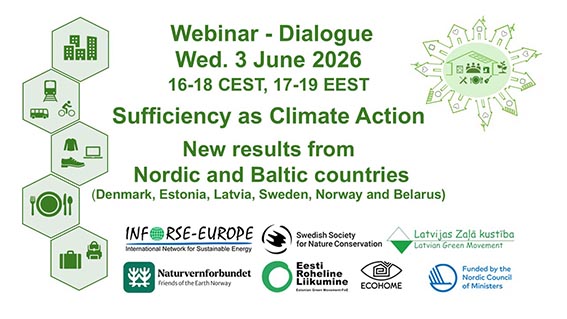
• Wed.
3 June, 2026 - 16-18 CEST, 17-19 EEST
Webinar
Dialogue on Sufficiency as Climate Action - New Results from
Nordic-Baltic Countries
How to improve sufficiency measures leading to more
sustainable lifestyle practices?
* Presentation of surveys, experiences and proposals from:
** -
DENMARK - ESTONIA - LATVIA - NORWAY - SWEDEN - BELARUS
* Dialogue on 5 main types of consumption:
** - BUILDINGS - TRANSPORT - PRODUCTS - FOOD
-
HOLIDAYS. |
| |
| |
|
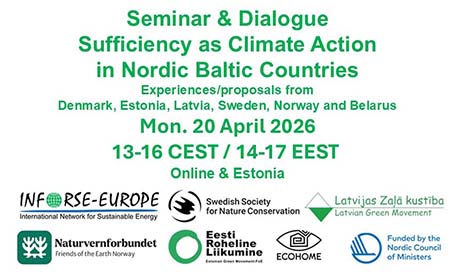
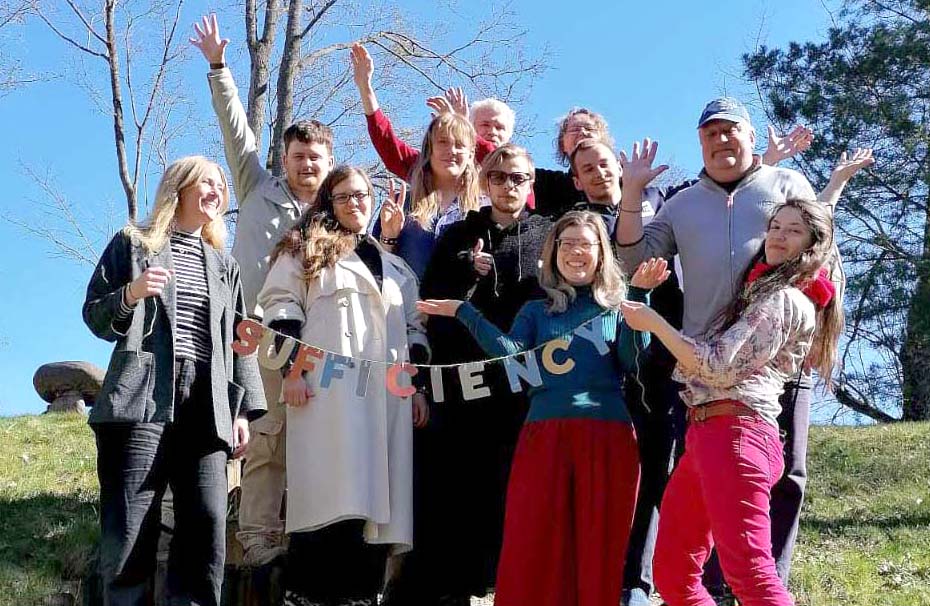
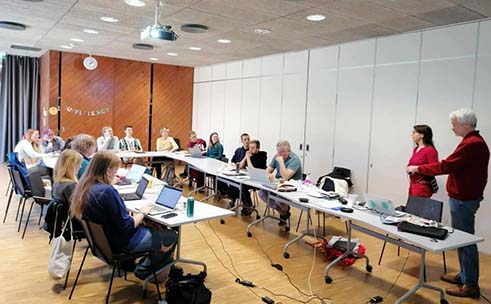
Mon.
20/4 2026 at 13-16 CEST / 14-17 EEST (online
part of a Project's Seminar in Tartu, Estonia).
Seminar: Sufficiency as Climate Action - Nordic Baltic
Countries - Experiences and proposals from:
Denmark, Estonia, Latvia, Norway, Sweden and Perspectives
from Belarus.
The
seminar presented results of surveys, and proposals for sufficiency
policies and how to communicate them, followed by dialogues and
further development of proposals with participants.
Download the presentations:
- Introduction
to the Project "Sufficiency as Climate Action" (pdf) by
Gunnar Boye Olesen, INFORSE-Europe
- Sufficiency in Sweden
(pdf) by Marit Widman, Swedish Society for Nature Conservation
- Sufficiency in Norway
(pdf) by Sofie Van Canegem, Norwegian Society for the Conservation of Nature
- Sufficiency
in Denmark (pdf) by Gunnar Boye Olesen, INFORSE-Europe
- Sufficiency in Estonia
(pdf) by Juta Kruusmae, Estonian Green Movemnent
- Sufficiency
in Latvia (pdf) by Janis Matulis, Latvian Green Movement
- Sufficiency
in Belarus (pdf) by Irina Sukhy, Ecohome |
 |
 |
| |
About
the Project: |
Summary:
To
stabilise global temperatures, we need additional
climate action,
and the purpose of the project is to work for inclusion
of a new category of climate action, in
the form of sufficiency policies with
the objective of having these policies included
in climate actions in the Nordic-Baltic countries.
The sufficiency policies include policies for reductions
of consumption for instance of
transport, housing, and goods as well as policies
for replacement of more resource-consuming consumption, as
replacing car travel with bicycling for shorter distances.
The project will collect sufficiency policies and practices,
including from environmental and consumer organisations. This
will be used
to develop concrete proposals how sufficiency
policies could attract and mobilize consumers. The project will
also organize
dialogues with environmental and youth CSO’s, develop
national and a regional policy proposals, present for Nordic parliamentarians, and organize
outreach including a youth camp in Latvia and a Nordic-Baltic seminar.
|
- Objectives:
- - To
make sufficiency policy measures known and
accepted as climate policies.
- - Strengthen
advocates for sufficiency policies so they better can advocate
for sufficiency policy measures, and thereby
ultimately achieve implementation of these policies as climate policies.
- - Strengthen
the basis for a successful transition to climate neutrality.
|
- The activities will include:
- -
Start-up online seminar and a regional Project
meeting in Estonia.
- -
Description of sufficiency measures and identify
how they can be part
of Nordic-Baltic climate policies. This
will include collection of sufficiency
measures proposed and realised as well as a survey
with a questionnaire for green consumer
projects
and organisation representatives in the
Nordic and
Baltic countries. The survey
will
collect experiences from e.g. Nature Conservation
Societies, Climate Movement, Consumer
Associations in the Nordic and Baltic countries
that
have been working for several decades with
consumers on good environmental
choices (e.g. Bra Miljoval in Sweden, Nordic
Swan). The results will be used to develop concrete
proposals
how sufficiency policies could attract
and mobilize consumers. The development
process will be carried out with help of
interviews and literature analysis and result in
a description
of the chosen sufficiency
policy measures and a briefing with detailed
recommendations how to communicate concrete sufficiency
measures.
- - Organise
dialogues on and introduction to sufficiency policies.
This will include national dialogues
(physical and online) and a regional online
dialogue
with environmental organisations
and interested
stakeholders, a web site presentation,and
dialogues with youth environmental organisations.
- - Develop
national policy papers with proposals
for each country, including
a list of energy sufficiency
mitigation policies proposed/supported
by environmental organizations
in the country, and a joint policy paper
for the countries
covered by the project.
This will be
based on the joint activities
with joint descriptions of sufficiency
measures
and
results of dialogues.
- - The
Belarus partners are working from Lithuania and Poland and
will work on the above activities,
providing people, both inside
and outside Belarus,
knowledge about policy options leading
to more
sustainable developments.
The project will also
help the
Belarus
CSOs to include sufficiency
measures in their ongoing work for
long term strategies and visions
for a Green Belarus.
- - The
outreach will
be with newsletters
national and international
(Sustainable
Energy News), webinars,
distribution
of policy papers, physical
dialogues
with CSOs,
presentation
for Nordic Council
Committee
for a Sustainable Nordic
Region, events,
social media, and
partners' web sites.
Specific events
will be a youth
environmental camp
in Latvia, and a Nordic-Baltic,
energy and climate
sufficiency seminar
in Denmark, both in
the
summer
of 2026.
|
- Background:
- - The
partners have cooperated in previous
projects including
"Better
Green Deal", and want to focus together
on issues
that are important for sustainable development
of the countries,
where the partners are located (Denmark, Norway, Sweden,
Estonia, Latvia, and Belarus).
We
need additional climate action
to mitigate climate change, and
the purpose of the project is to work for inclusion
of
a new category of climate
action, sufficiency policies,
with the objective of having
these policies included in
climate
actions
in the Nordic-Baltic countries.
Energy
and resource sufficiency has
received increased attention in
recent years as a compliment
to energy and resource efficiency concepts (e.g.
in IPCC 6th assessment report
WG3, 2022). Whereas
energy efficiency is to
reduce energy input for a specific energy output,
energy
sufficiency is about avoiding unnecessary
energy
(and resource) consumption
(FULFILL
2024).
- -
The sufficiency concept can
be described
as policies,
measures
and daily
practices
that avoid
the demand
for energy,
materials,
water
and land
while
delivering
human
well-being
within
the
planetary
boundaries.
Sufficiency
is a
concept
that
has
not
been
so articulated
in the
past,
even
though
the
actions
have
been
well
known.
The
realisation
of some
actions
are very
straight
forward,
and
provides
direct
results
in terms
of reduced
energy
demand. Examples
are to
take
the
bus
or
train
instead
of
an
individual
car
for
traveling
from
one
place
to
another
saving
energy
and
at
the
same
time
reducing
occupied
space,
reducing
greenhouse
gas
emissions
and
cost
for
transport.
This
example
of
a modal
shift
has
multiple
benefits
and
gives
direct
impacts. The
challenge
lies
in making
this
happen –
in many
cases
the
decision
on taking
the
car
or
the
bus/train
will
be
on
an
individual
level
while
impacts
are
on
system
level.
- -
Sufficiency actions
have many forms, reducing the need
for high-emission transport, large housing and large material
consumption.
Sufficiency policies and strategies implemented at societal
level would
stimulate, nudge and regulate towards fulfilling the energy
sufficiency potentials.
Good sufficiency policies are about making it appealing
to choose the less consuming options, not about banning
consumer choices.
Many sufficiency policies will also contribute to a
more equal society, including gender equality,
when for instance
the need for a car or a large house is reduced. There
are also health
and well being benefits e.g.
when replacing car driving with
bicycling.
|
Partners:
|
The
project is funded by the Nordic
Council of Ministers' Prosperous Future Grants Programme
for Civil Society Cooperation, and
co-financed by project partners
- Svenska
Naturskyddsforeningen, Norges
Naturvernforbundet and INFORSE-Europe.
The views and opinions exressed are those of the partners, and do
not necessarily reflect those of the financial supporters.
|
|
|
|
 -
-


 Nuclear
Energy
Nuclear
Energy Gender
 Structural
Funds
Structural
Funds Sufficiency
as Climate Action and for Sustainable Lifestyles in Nordic & Baltic
Countries and Belarus -
2025-26
Sufficiency
as Climate Action and for Sustainable Lifestyles in Nordic & Baltic
Countries and Belarus -
2025-26