Dashparni ark - botanical pesticide
| Categories: |
| Organic composting |
| Countries: |
| India |
| Language: |
| English |
| Description of what does the solution provide: |
| Dashparni ark is a botanical pesticide prepared from the leaves of ten different plants. It develops immunity within plants and shows antiviral, antibacterial, and antifungal properties. It keeps harmful insects away from plants & prevent infestation. Due to its strong odour, it protects plants from pests and diseases infestation for a longer period. |
| Savings in resource use per day: |
| The Dashparni ark reduces input costs up to INR 1000 /application for the one-acre area. It can reduce the cost of pesticides up to INR 4000/ha/crop/season and also reduce the cost of spraying agrochemicals. It reduces the cost of traveling for purchasing the pesticides from markets is up to INR 200 to 300 per application. |
| Cost in money and in own time to construct: |
| The cost of preparation is about INR 1500. Out of the total cost INR 1200 is a one-time investment for purchasing the plastic drum. The remaining INR 300 is for the collection of leaves of ten types of plants, cow dung and cow urine. It takes 30 days to prepare the solution. |
| Lifetime, years: |
| It can be used for up to 6 months. If the solution is stored properly, it can be used for additional six months. |
| Maintenance needed: |
| It should be stirred every day in the morning and evening to mix the content in the drum and release the gases. Additionally, the drum should be kept in the shade and covered with a muslin cloth. and the drum cover should not be tight. |
| Resources needed in use: |
| Leaves of neem (Azadirachta indica) 5 kg, leaves of ghaneri (Lantena camera) 2 kg, leaves of karanj (Pongamia pinnata) 2 kg, leaves of kanheri (Nerium indicum) 2 kg, leaves of castor (Ricinus communis) 2 kg, leaves of gulvel (Tinospora cordifolia) 2 kg, leaves of custard apple (Annona squamosa) 3 kg, leaves of rui (Calotropis procera) 2 kg, leaves of papaya (Carica papaya) 2 kg, leaves of nirgudi (Vitex negundo) 2 kg, cow urine 5 litre, cow dung 2 kg, water 170 litre, plastic drum (capacity) 200 litres. |
| Problems and limits in use: |
| The solutions has short storage life of 6 months. The raw materials particularly the leaves of all ten plants may not be available at each location. The contamination with bacteria or any other organism may ruin the whole solution. The strong bad odour may hinder farmers to prepare it. |
| Where and how can you get it or make it: |
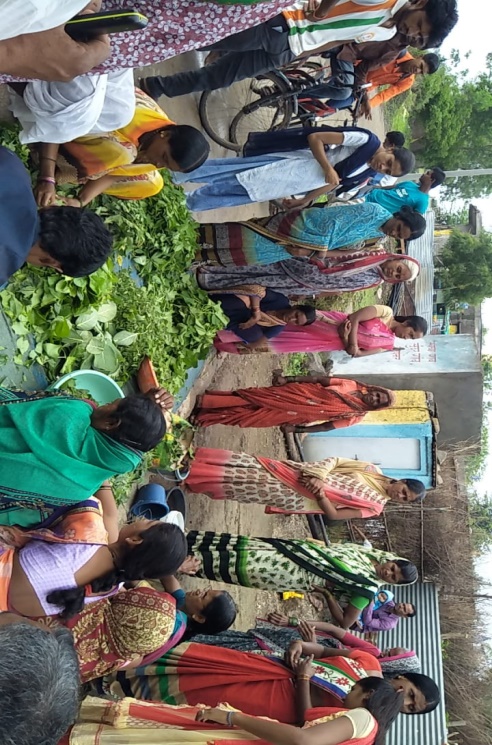
| The native cow urine & dung from the village could be collected. The advantage is that the raw material is easily available at the village level. The plastic drum can be purchased from the local market. The mixture is collected by mixing all the content in a plastic drum. The mixture should be stirred with a wooden stick clockwise and anti-clockwise for 5-10 minutes every day, in the morning and evening. Keep it for 30 days in a shade. After one month, separate the Dasarpani ark through a sieve. Now the arck is ready for spraying. |
| Skills needed to produce, install, maintenance and use: |
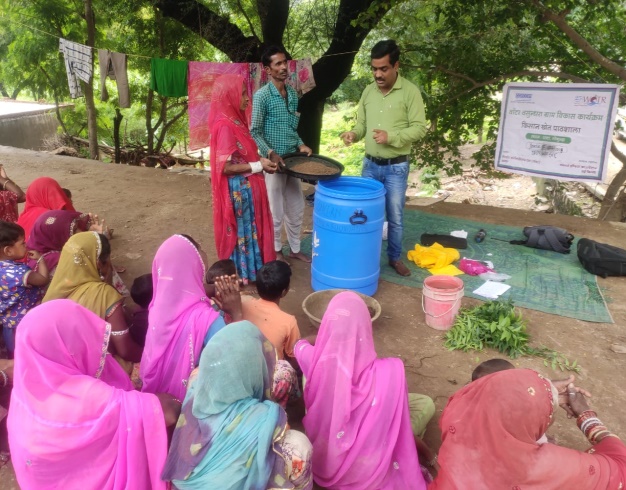
| Knowledge on detailed method of preparation of the dashparni ark is needed. Knowledge on different plants used for the preparation of the solution,, method of use, when to use and how much to use is needed. Initially, hands-on training is sufficient to train farmers for the preparation process. |
| Climate effect (if any): |
| The use of dashaprni ark for the management of pests and reduces the use of chemical insecticides. So it reduces the harmful effect of insecticides on beneficial insects, soil micro-organisms, as well as reduces the GHG emission from the agricultural fields. |
| Where is it used and how many users are there: |
| The solution has been promoted in WOTR project areas in different states of India i.e. Madhya Pradesh, Telangana, Odisha, Jharkhand, Rajasthan & Maharashtra. Approximately, in each village, more than 50 farmers are using it. |
| Why is it successful? Success factors: |
| It's a eco-friendly low cost biopesticide that can be easily prepared at the farm using local resources. It reduces the use of harmful insecticides as well as reduces the cost of pests and disease management. It does not have any harmful effect on the beneficial insects in the farm as well as it produces residue-free food. One of the success factors is one farmer or farmers group/SHG can prepare it and share it with other farmers. |
| What are the successful delivery and business model(s), and main actors: |
| The dashparni ark is prepared by farmers, FPOs, SHG, and farmers groups and sale to the other farmers in the village at a very low price than agrochemicals. |
| Which policies and strategies helped the success (if any), including subsidies: |
| At present, the Govt. of India launch a program on Paramparagat Krishi Vikas Yojana (PKVY) and Govt. of Maharashtra is implementing a project on climate resilient agriculture (POCRA) in Maharashtra through these programs the promotion of nature-based solutions is ongoing in the project villages. Through these projects, farmers are getting a subsidy for different CRA practices. |
| Other info: |
| Name of the Organisation - Watershed Organisation Trust (WOTR), Pune Established in 1993, WOTR is a non-profit organisation that engages at the intersection of practice, knowledge and policy across scales and in collaboration with various stakeholders across sectors. Our goal is to ensure water and food availability, along with livelihoods and income security – to support the sustainable growth and well-being of vulnerable and disadvantaged communities in rural India. Address: The Forum, 2nd Floor, Pune-Satara Road, Padmavati Corner, above Ranka Jewellers, Pune, Maharashtra-411009 Phone: 020 2422 6211 Email: info@wotr.org Contact Person Mr. Sachin Shrikant Adhe Junior Researcher, Climate resilient Agriculture Mo. 9011842084 Email: sachin.adhe@wotr.org.in |
| Organisational contact: |
| Watershed Organisation Trust, WOTR |
| External links: |
| youtu.be/l4zGtwhMQW8 |
| Short description of construction, typical problems, materials needed: |
| Date of post creation: |
| 2022-08-22 |
| Date of last changes: |
| 2023-10-03 |
The database for Eco-Village Development in South Asia was developed by the NGO cooperation project:
“Next generation low carbon, climate resilient Eco-Village Development in South Asia “ in 2021-23.
The database includes local sustainable solutions, media (photos, graphics, videos), publications, and organisations.
Read more at About
“Next generation low carbon, climate resilient Eco-Village Development in South Asia “ in 2021-23.
The database includes local sustainable solutions, media (photos, graphics, videos), publications, and organisations.
Read more at About